
04.02.2026
В последние месяцы сразу в нескольких странах Центральной Азии были сделаны заявления о надвигающемся дефиците водных ресурсов.

| Пн | Вт | Ср | Чт | Пт | Сб | Вс |
|---|---|---|---|---|---|---|
| « Фев | ||||||
| 1 | ||||||
| 2 | 3 | 4 | 5 | 6 | 7 | 8 |
| 9 | 10 | 11 | 12 | 13 | 14 | 15 |
| 16 | 17 | 18 | 19 | 20 | 21 | 22 |
| 23 | 24 | 25 | 26 | 27 | 28 | 29 |
| 30 | 31 | |||||
Код для вставки на Ваш сайт:
Уважаемые читатели, здесь приводится публикация на английском языке статьи «Морской бриз» на Чарваке вопреки законодательству Узбекистана. Перепечатка с сайта housing-uz.info. We offer you a translation of an article by renowned Uzbek journalist Nataliya Shulepina, covering environmental issues. All photos are taken from an article on the website www.sreda.uz.
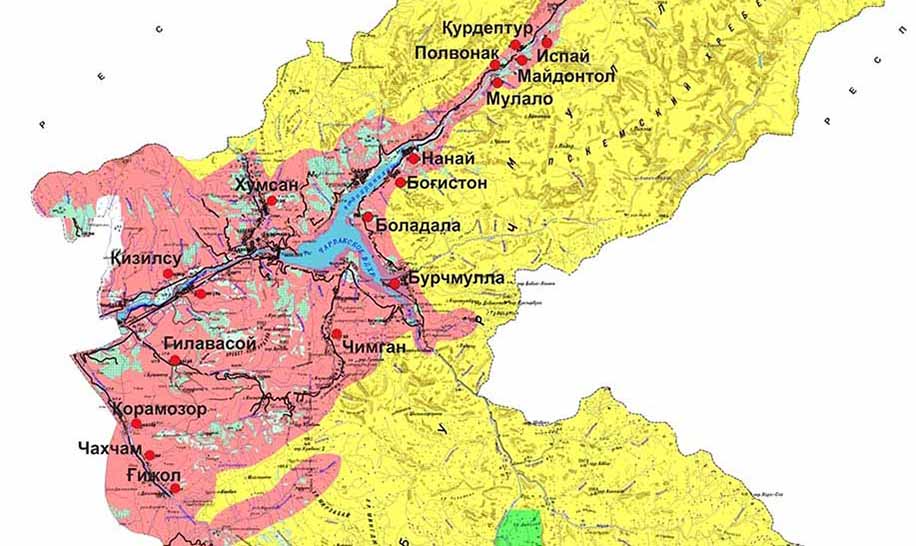
On the map: Charvak Reservoir in the center of the Ugam-Chatkal National Nature Park.
Public hearings in Gazalkent
In this publication, we will refer several times to Cabinet of Ministers Resolution No. 490 of August 1, 2025 entitled » 490-сон 01.08.2025. On measures for the implementation of a large-scale investment project on the establishment of the “Sea breeze Uzbekistan” all-season resort complex (Hereinafter it is referred as CMR No. 490)
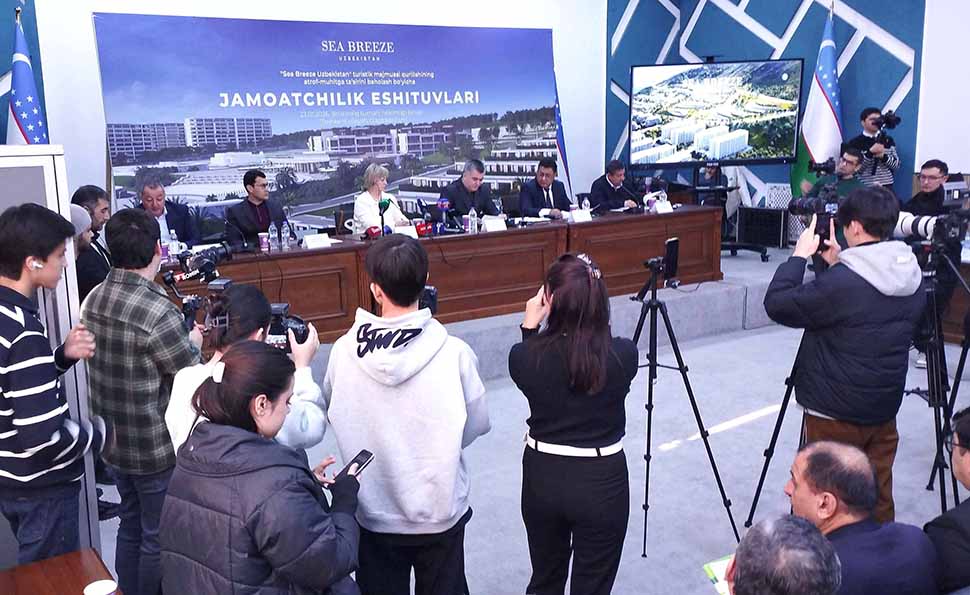
Paragraph 5 of the Resolution provides for the organization of presentation events and a large-scale advertising campaign through local and foreign media. The hearings were held on January 23, 2026, in the Bostanlyk District Administration. The presidium was attended by prominent figures, including the director of Sea Breeze Uzbekistan LLC, the deputy governor of the Tashkent region, the governor of the Bostanlyk district, and the head of the state environmental review of the National Committee on Ecology and Climate Change.
The hall was filled with farmers who had lost their land, specialists and experts invited from abroad, as well as journalists, bloggers, and activists. A general outline of the project was presented, involving the development of two opposite banks of the reservoir. They will be connected by a bridge.
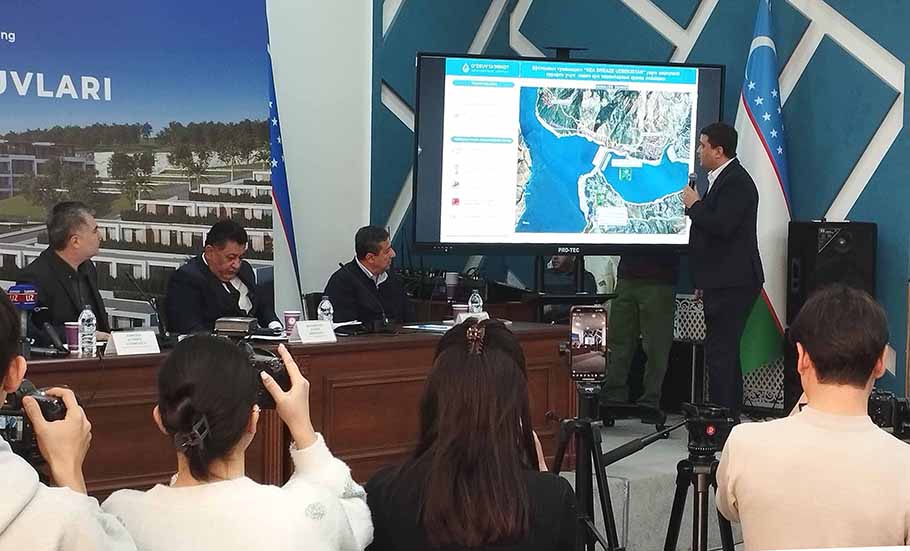
The bridge will connect Sea Breeze with the highways to Tashkent. The villages of Boladala and Yakkatut, located on either side of the bridge, will receive tourist status. For the construction of the resort town, the Cabinet of Ministers has allocated 577 hectares in the Ugam-Chatkal National Nature Park, plus another 50 hectares for the laying of communications.
But the developers have not yet received that much land. According to the director of the Sea Breeze Uzbekistan, some preparatory work had been completed on one site on a mountain slope, with the ground leveled for the foundation. These works were done without environmental impact assessment. However, the developer believes that this does not prevent work from starting: the Cabinet of Ministers’ Resolution states: “As an exception, within the framework of the project implementation, construction and installation work may be carried out simultaneously with the development of design and estimate documentation until December 31, 2029.”
It should be noted that this is one of the most controversial points concerning the construction of a resort on the shores of Charvak. The Urban Planning Code (2021) does not provide for any exceptions. Article 47, “Prohibitions and restrictions on the development and implementation of urban planning documentation,” states that the construction and reconstruction of facilities, regardless of their sources of funding, with the simultaneous (parallel) development of urban planning documentation is prohibited.
This same mandatory principle is enshrined in building codes and regulations: SHNK 1.03.06-2013 “Rules for Conducting State Expertise”. A positive conclusion from the state expertise is required for project approval and the issuance of a building permit.
So far, we are talking about urban planning expertise, not environmental expertise.
The Decree of the President of the Republic of Uzbekistan RP-300-сон 11.09.2023. On measures for the quality and timely implementation of the “Uzbekistan-2030” Strategy in 2023 is directly related to environmental expertise. Paragraph 11 requires for introducing “ a mechanism for suspending financing, lending, and other financial transactions for projects that have not received a positive environmental impact assessment.” The same paragraph imposes “on persons who have committed an environmental offence the obligation to restore and ensure the protection of damaged natural objects for a specified period, along with compensation for losses.”
In February 2025, the Law of the Republic of Uzbekistan LRU-1036-сон 24.02.2025. On environmental expertise, environmental impact assessment, and strategic environmental assessment was adopted. Its article 22 is entitled: “Mandatory compliance with the conclusions of the state environmental review” and it prohibits “the financing of the projects by banks and other credit institutions, as well as their implement them without a positive conclusion from the state environmental review.” What funds and bank transactions were used, despite legal prohibitions, to fence off the construction site in the summer and fall of 2025? The territory, which has protected status, was bulldozed, excavated, and dumped.
What is required by Uzbek law?
The audience at the public hearing expected to hear information on other issues outlined in Resolution No. 490, in particular, on the legality of large-scale construction in the Ugam-Chatkal National Nature Park, which is prohibited by law.
Let us recall the current Law 710-II-сон 03.12.2004. On protected natural areas. This law prohibits “any activity that contradicts the purpose of the national park and threatens the preservation, reproduction, and restoration of plants objects on the territory of the national park.” (Article 45).
In the water protection zones, coastal strips, sanitary protection zones for water bodies, and zones for the formation of surface and groundwater it is prohibited the following:
– cutting down trees and shrubs;
– storing and burying waste;
– constructing wastewater treatment facilities and wastewater storage facilities; any type of construction, except for the construction of water management facilities . (art.41 of the Law #710)
The photo below illustrates what was observed in the summer and fall of 2025 at the Sea Breeze construction site: the water protection zone has been destroyed, and vegetation has been cleared. On the drained bottom, car tracks are clearly visible up to the receding Charvak water. 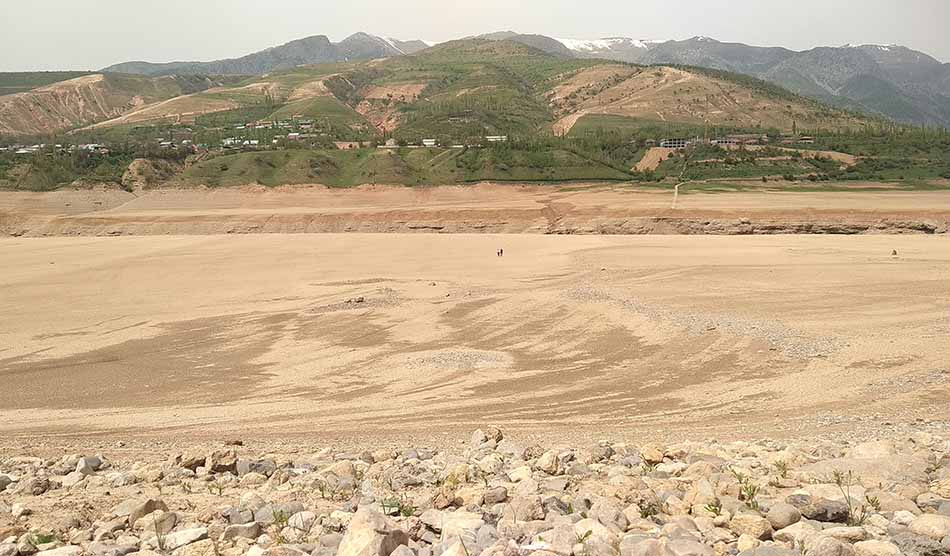
What is required under the country’s international obligations?
In 2016, Ugam-Chatkal National Park was included in the UNESCO World Heritage List as part of the UNESCO World Heritage Site “Western Tian Shan”. It falls under Uzbekistan’s standard obligations under the 1972 Convention Concerning the Protection of the World Cultural and Natural Heritage (ratified by Uzbekistan in 1993).
Every six years, Uzbekistan is required to submit reports to the Secretariat of the World Heritage Convention assessing the integrity, threats, and management effectiveness of the Ugam-Chatkal National Nature Park. The 2015–2021 report confirmed the integrity of the site. The next cycle should cover the period from 2022 to 2028.
A joint mission by UNESCO and the International Union for Conservation of Nature and Natural Resources (IUCN) to the Western Tian Shan Mountains in the fall of 2024 also visited the Ugam-Chatkal National Park. It identified serious threats : UNESCO-IUCN mission visits Western Tian Shan amidst growing threats to the World Heritage – Rivers without Boundaries
As part of the Western TianShan, the Ugam-Chatkal National Nature Park is also covered by the Ramsar Convention (wetlands of the Charvak Reservoir) and the Convention on Biological Diversity.
What are the benefits of participating in conventions?
In addition to prestigious international recognition, Uzbekistan receives international grants. For example, on November 25, 2025, as part of the Conference of the Parties to the CITES Convention in Samarkand, a grant agreement was signed between the National Committee on Ecology and Climate Change, UNDP, and IUCN to implement the EcoLand project with a total budget of US$6.1 million. The project aims to scale up innovative integrated approaches to ecosystem restoration and conservation in key landscapes of Uzbekistan.
Neither Sea Breeze Uzbekistan LLC nor the National Committee on Ecology and Climate Change mentioned anything about obligations under environmental conventions at the hearings.
What does the Resolution #490 say about nature and its protection?
Paragraph 5 of Resolution No. 490 provides for «the implementation of the project in accordance with environmental requirements, including the prevention of waste and wastewater discharge into the Charvak Reservoir and the Chirchik River during the project implementation period and after its commissioning, as well as measures to direct wastewater to the Chirchik city treatment facilities». This is one of the main obligations of Sea Breeze Uzbekistan LLC. Failure to comply with the requirements is grounds for termination of the project and termination of the land lease agreement.
Paragraph 10 specifies the responsibilities of the environmental agency. At the time the Resolution was adopted, this was the Ministry of Ecology, but now it is the National Committee on Ecology and Climate Change (hereinafter — National Committee). What tasks has it been set?
During the implementation of the project, the National Committee, together with the Ministry of Construction and Housing and Utilities, should establish control over compliance with the requirements for water protection zones of the reservoir and the coastal zone. These two agencies should ensure that construction work is not carried out in protected natural areas, water protection zones, and sanitary zones, and should establish strict controls to prevent the discharge of wastewater into the reservoir.
In cooperation with the Prosecutor General’s Office, the Natioonal Committee has been instructed to ensure constant and comprehensive control over the Charvak Reservoir and its sanitary protection zone in order to prevent the discharge of domestic and industrial waste and wastewater, as well as to take strict measures to eliminate environmental pollution, compliance with sanitary and environmental standards, and maintaining a healthy ecological environment.
The National Committee has also been instructed to work with the Cadastral Agency to conduct an inventory of buildings and structures in areas adjacent to the Charvak Reservoir, including those under construction. If they do not comply with environmental requirements and pollute the environment, the Agency ensure their demolition and take legal action against those responsible.
The participants in the public hearings did not hear a single point from the report on the eradication of violations around Charvak. Meanwhile, six months have passed since the Resolution came into force.
Numerous structures built on the slopes in recent years are depleting springs and mountain rivers, polluting the environment, and discharging sewage into the terrain and streams that flow into the reservoir and the Chirchik River.
Have these facilities been identified and demolished? Have those responsible, including those who sell land to developers in protected natural areas, been held accountable? No.
According to the specified clause of Resolution No. 490, responsibility lies with the head of the National Committee. Neither he nor his deputies were present at the public hearings. The presidium suggested writing notes with questions and throwing them into a box. “You will definitely receive a response”, they said.
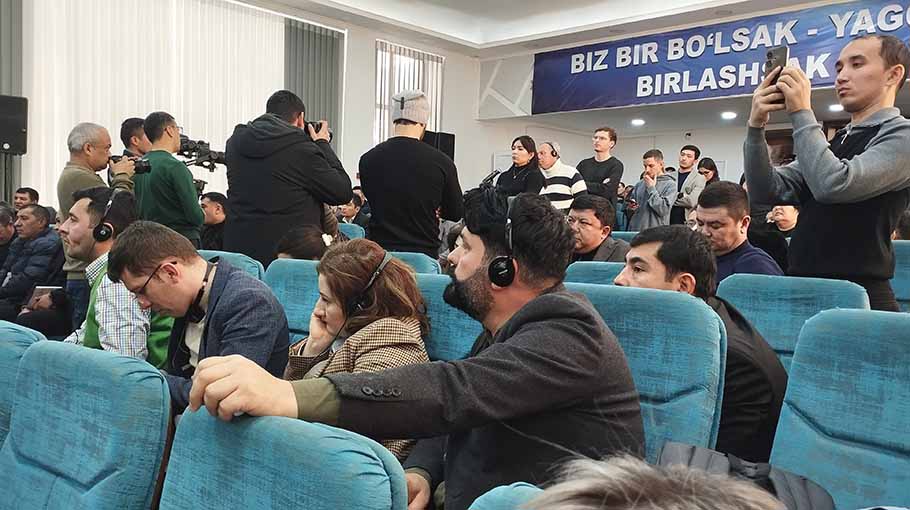
Questions from the audience
After brief official statements, the presidium turned on the microphone for questions from the audience. There was no discussion of investments, lots, long-term leases, or the distribution of financial resources. The questions asked were those that ordinary people would understand.
The director of Sea Breeze Uzbekistan promised to plant 10,000 trees in the designated area to replace the felled trees and shrubs, and to bring in new species, including palm trees. “Palm trees can withstand temperatures of minus 20 degrees and will acclimatize”, he said
The Law “On Protected Natural Areas” prohibits the introduction of new species and subspecies of living organisms for the purpose of acclimatization. A similar ban applies to nature reserves (art. 25). Insects from palm trees and other imported species will breed and acclimatize in the UNESCO World Heritage Site. The import of palm trees and other species into the national nature park contradicts Uzbekistan’s international obligations.
A question was asked about air pollution.. “In Tashkent, it has become impossible to breathe due to violations of building codes and regulations. Tashkent ranks among the worst in terms of air quality. In all seasons, city residents travel to the Charvak area for clean air. Construction on the Charvak shore is planned until 2035. Will we be breathing construction dust?”
A question was asked about the discharge of dirty wastewater into the reservoir during construction. Answer: “We have already built local treatment facilities. There will be treatment. Untreated wastewater will not enter Charvak.”
Hold on, what about the ban in Article 41 of the Law “On Protected Natural Areas” on the construction of wastewater treatment facilities and wastewater storage facilities? Paragraph 5 of Resolution No. 490 on the same ban.
It is time to turn to the Water Code. It came into force on October 31, 2025, replacing the 1993 Law “On Water and Water Use.” We refer to Article 126 of the Water Code, which contains regulations for water protection zones and coastal strips of water bodies, as well as sanitary protection zones for drinking and domestic water supply facilities. It is similar to the article in the previous law. It is also similar to Articles 40 and 41 of the Law “On Protected Natural Areas.”
Let us carefully read Article 108 of the Water Code, “Procedure for the use of water bodies in protected natural areas and measures for their protection.” It states: “The discharge of wastewater into water bodies of state reserves, complex (landscape) reserves, nature parks, and state biosphere reserves is prohibited.”
A question was asked from the audience about the prospects for sewage drainage from the large coastal complex. An employee of UzSuvtanot (Uzbek public company for Water supply) replied: “There will be two pipes, each with a diameter of 100 mm, laid inside a large pipe with a diameter of 1400 mm.. The cost of the sewer collector is $10 million.” No details were given about the route. Probably, in order to reduce the mileage and budget, it will be “tied” to the planned bridge over Charvak. As for the ability of the pipes to carry the sewage of a resort town with a population of ten thousand, that’s a question for the box.
Who guarantees the safety of the sewer pipe?
No one guarantees it. The pipe, laid on the right bank in the early 2000s, already needs repair. Leaks were noted on its way to the city of Chirchik to the treatment facilities, including leaks above the Charvak Reservoir bay. The pipe was hung over the bay at the time to save money. This decision was not part of the project. It was made along the way. Three years ago, the cable-stayed bridge with the pipe over the bay was repaired. There were no safety guarantees then, and there still aren’t any now.
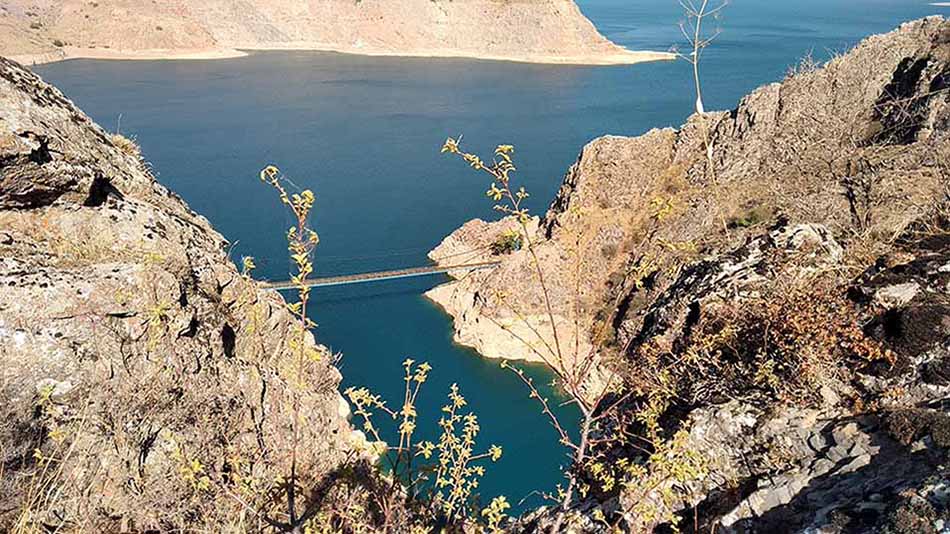
We are concerned about drinking water for millions of Uzbekistan citizens in the event of a rupture in the existing sewer pipe.
The route of drinking water for Tashkent residents: after passing through the turbines of the Charvak Hydroelectric Power Plant and the cascade of hydroelectric power plants downstream of the Chirchik River, mountain water from Charvak reaches the capital through the Bozsu Canal. The water undergoes treatment at purification facilities and is supplied to city residents’ homes through the water supply system.
Is the Charvak half full or half empty?
In a wet year, two cubic kilometers of water from mountain rivers flow into the reservoir. This is enough for drinking water supplies and for irrigation by Uzbek and Kazakh farmers. The Syr Darya, which is 150 kilometers long from the Chirchik River (starting from the reservoir dam), also gets its share, feeding the Kazakh lowlands and reaching the Small Aral Sea.
The Charvak Reservoir is fed by the Pskem, Koksu, and Chatkal rivers. The fact that cascades of hydroelectric power stations are being built on these mountain rivers in the Western Tian Shan caused alarm and concern for the UNESCO and IUCN mission in 2024. The construction of hydroelectric power plants on the mountain rivers of the UNESCO World Heritage Site is not in line with the countries’ commitments. Hydroelectric power plants lead to changes in natural landscapes and river regimes. And if this continues, nothing will remain of the World Heritage Site.
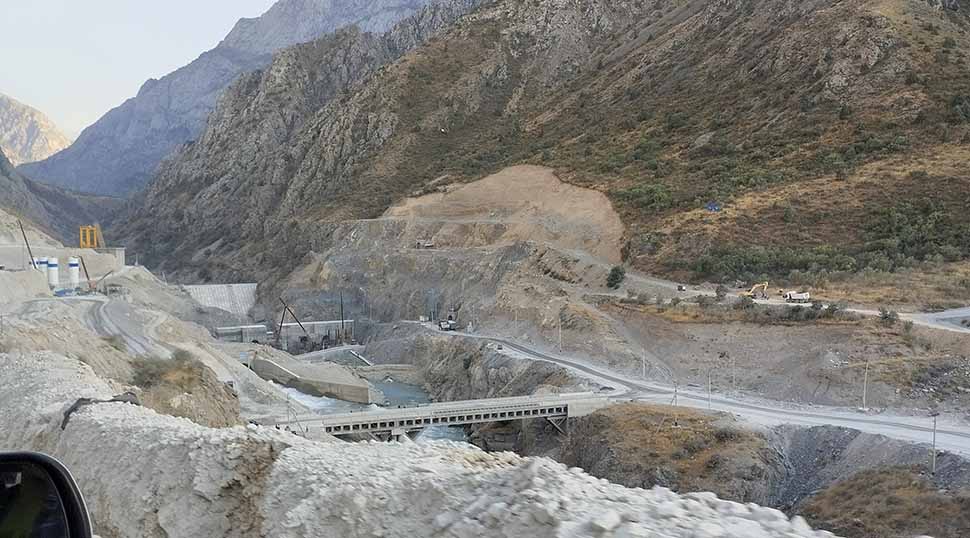
Chatkal River. Construction of the Quyi Chotqol Hydroelectric Power Plant has been underway since 2019.
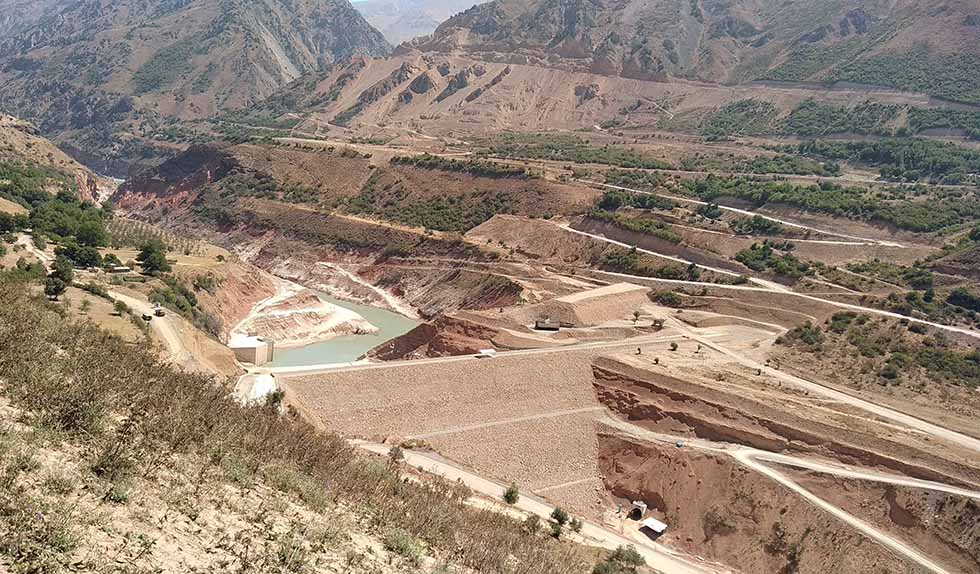
Hydroelectric power plant on the Pskem River. The riverbed was blocked in November 2021. Construction is ongoing. These photos are from 2024.
To forecast river flow, it is necessary to know the situation in the upper reaches. Data from the inventory of glaciers in the Talas Alatau, where the Pskem River originates, for 1957, 1978, and 2010 show a decrease in ice volume from 3.469 cubic kilometers to 2.625 cubic kilometers. For more details, see the scientific publication by NIGMI (Scientific Research Hydrometeorological Institute of the Hydrometeorological Service Center) of Uzgidromet, “Changes in the glaciation of river basins with a predominance of small glaciers in the second half of the 20th century and the beginning of the 21st century.”
Hydrological modeling of changes in the flow and water regime of the Pskem River up to 2100 has revealed that, under any climate change scenario, the peak flood season on the Pskem will shift from June to May.
This is what the upper part of Charvak looked like in April 2022. The canyon along the shore is the Pskem riverbed.
The reservoir begins to fill when the snow in the mountains melts, followed by the glaciers. The driest year in the last forty years was 2025. The Charvak Reservoir did not manage to fill to its designated capacity of two billion cubic meters by the summer. With climate change, there have been more hot days. Last summer, May was abnormally hot. The period from April to November was extremely dry and became a great challenge for water managers and farmers who shared the water.
We refer once again to the Water Code to understand how water is distributed and how much water a resort town needs.
Article 65 defines the procedure for allocating water intake quotas. Quote: “It is not permitted to refuse to allocate a quota for water intake for drinking water supply.” Who would refuse resorts? When quotas are allocated, farmers will be last in line.
Let’s summarize
In this article, we have not covered all the issues raised at the hearings or submitted to the “box.” We will return to them later. As for projects that are attractive for investment, there are no exceptions for them in Uzbekistan’s laws. The country’s main law, the Constitution, leaves no room for double interpretations. It states: “The land, its subsoil, waters, flora and fauna, and other natural resources are the national wealth, subject to rational use and protected by the state.”
By Nataliya SHULEPINA, SREDA.UZ : Экология: Фото, Туризм, Узбекистан
Translated by Farida Sharifullina

Добро пожаловать на канал SREDA.UZ в Telegram |
В последние месяцы сразу в нескольких странах Центральной Азии были сделаны заявления о надвигающемся дефиците водных ресурсов.
Десятитысячный курортный город «сажается» на Чарвакское водохранилище вопреки законодательству Узбекистана и международным обязательствам.
Международный водный форум пройдет в Ташкенте 25 — 26 марта 2026г. по теме «Технологии и инновации в управлении водными ресурсами. Центральная Азия и глобальный водный цикл».
В новом совместном отчете ФАО и ВОЗ освещается важная, но часто упускаемая из виду проблема: химическое загрязнение воды, используемой в агропродовольственных системах.
Наступили времена, когда командировки стали редкостью и каждая как подарок. Мне 2025 год пожаловал несколько таких подарков, причем и по Узбекистану, и за рубеж, включая Будапешт.
Экспедиция водников Узбекистана и Казахстана началась в Ташкентской области. Там осмотрели ряд объектов, включая Верхнечирчикский гидроузел. Следующие объекты расположены в Сырдарьинской области на канале Дустлик.
Большую часть маршрута водники из Узбекистана проделали вместе с коллегами из Казахстана, осмотрев ключевые водохозяйственные объекты в Ташкентской и Сырдарьинской областях.
Диалоги проводятся с целью собрать все заинтересованные стороны по каждому речному бассейну для обсуждения совместных действий по рекам. Вот и в этот раз встретились водники из Кыргызстана, Таджикистана, Туркменистана, Казахстана, Узбекистана.
Процесс присоединения к Конвенции ЕЭК ООН о трансграничном воздействии промышленных аварий не прост. Приходится решать много самых разных задач, начиная от инвентаризации опасных объектов до предотвращения загрязнения вод.
Водный кодекс Республики Узбекистан утвержден 30 июля 2025 года. Вступил в силу — 31 октября 2025 года. На сайте Министерства юстиции размещены тексты Водного кодекса на узбекском, русском и английском языках.







Sreda.Uz работает с 2009© Блог НАТАЛИИ ШУЛЕПИНОЙ
shulepina@bk.ru

При цитировании и/или копировании материалов сайта активная ссылка обязательна
«Морской бриз» на Чарваке вопреки законодательству Узбекистана
Ангелина
Большинство туристических агентств прекратили поездки в Чарвак. Походы на любимые известные водопады стали труднейшими переходами вдоль перерытых рек Чаткал, Пскем, Коксу. И это в тоже самое время, когда в Берне люди добираются домой с работы вплавь по городской реке, из которой можно пить. Плывут и пьют. Похоже, те кто курочат наши заповедники, поедут потом жить в Швейцарию. Помните, когда мы выезжаем из города отдохнуть, мы не хотим жить в таких же многоэтажках, как в городе. Нам нужна тишина, айван у воды и узенькие тропинки среди зелени, а не асфальтовые трассы. И иностранцы не станут преодолевать тысячи километров, чтобы жить в таком же отеле, какой у них есть дома. Надеюсь дожить до момента, когда все эти сооружения будут снесены, а застройщики вернут свои накопления людям, у которых они отняли малую родину. Потомки же этих застройщиков откажутся носить их фамилии.
Госархстройнадзор отрицает контроль за реконструкцией ташкентских высоток
комменты из фэйсбука
Н.Бахтиярова: Это сделать действительно трудно, потому что деньги уже в кармане Некоторых чиновников. Если Гос. Власть с таким аппаратом Гос. структур не в состоянии решать проблемы, тогда зачем такие структуры? Даже если взял Кто-то из Госчиновников мзду, вычислить можно - без проблем. Так как в наше время стало Инновационно обращаться к иностранным институтам, пущай обратятся за помощью! Хамитжанова: И так во всех госструктурах, куда ни обратишься, везде один ответ- никто ни за что не отвечает. Ни с кого нет спроса... Е.Г. Однозначно лучше вид фасада. О жителях, конечно, не подумали. Жителям стало неудобно жить Аноним: Архстройконтроль надзорит объекты, включенные в смету проекта. Martin: Не дай бог жить в таких современных небоскребах! Н.Хан Эту красоту ветром не снесёт? Зубанов: Если майнушки саморезы не склюют, то не должно. Но они такие... Как те сомы. В мае посмотрим.... Деканова: Ну если на Шота Руставели навесы- козырьки новые посваливались, то все может быть...
Госархстройнадзор отрицает контроль за реконструкцией ташкентских высоток
комменты из фэйсбука
Александр: Министерство на эшафот. Алишер А: Лайфхак от ИИ Повесьте объявление: Эй, товарищ, ты туда не ходи Ты сюда ходи! А то стекло башка попадёт, Совсем плохо будет. Яковлев: Прочитав статью, утвердился в своём убеждение, что система госуправления полностью разрушена. Автору спасибо за профессионализм! Рашит И. : Не понятно - Гос. власть не в состоянии решить данную проблему, всех привести в чувство, прекратить эту Канитель? Странно. Как же решают более глобальные вопросы? Можно ведь создать Комиссию - группу, включить в неё активистов, которые борются за свои права, специалистов госнадзорных структур, прокуратуры, представителей исполнительной власти и т.д и т.п. Таких структур ведь много создали в Государстве, и расставить все точки.
Госархстройнадзор отрицает контроль за реконструкцией ташкентских высоток
комменты из фэйсбука
Макарова: Какая то бутафория, г..ляпство. Ан: Вот это поворот! Л.В.: Ну не факт, что будет красота. У нас же как - дёшево и сердито, себя любимого тоже надо не обидеть. Zair: Ташгорхренстрой. Дуремар: «А я тут не при чем. Совсем тут не причем»...
Госархстройнадзор отрицает контроль за реконструкцией ташкентских высоток
комменты из фэйсбука
Павел: Ну, правильно ответили:- по документам ведь не реконструкция, а простой ремонт. На ремонт никаких разрешений ни от кого не требуется... А что потом будет - уже совсем другой вопрос! Вл.Ш.: Ну, раз деньги выделены, то уж распилят по любому. Результат неважен))- Пусть жители проклинают и возмущаются. Пусть через год придется переделывать или снимать все сделанное! Освоить бабло - это святое!)) E.Au. А у нас уже давно организации забыли, зачем они существуют. Но почему? Может потому что исполнительная власть приобрела статус верховенства?
Изменения в фауне Ташкента за восемьдесят лет. Наблюдения Бориса Пономарева
Anvar Ходжаниязов
Я могу рассказать только про 80-е. Да, все верно. В дувалах скорпионы. В небе ласточки и стрижи. Удодов редко, но видели каждый год. В арыках маринка, пескари, сомики, змеи (ужи, желтопузики), лягушки, комары были, да. В каналах ловили мотыля и червя - корм для рыб продавали на Тезике. Вечерами полно летучих мышей. Переходил в брод Чирчик, возле Куйлюка, мимо ног стаи больших рыб проплывали. В домах, даже многоквартирных, были гекконы и ящерицы. Теперь о причинах. Считаю, главный не пищевой фактор, а фактор распространения человека, уплотнения населения, строительства новых домов. Там, где были пустыри и огороды, теперь застроено все. Количество автомобилей возросло на порядок и больше. Вода перестала поступать в арыки. Деревья засыхают, их вырубают, даже те, которые приспособились. Местообитание птиц сокращается, деревьев меньше. Выхлопных газов больше. Вообще климат стал более сухим и негде животным обитать, поэтому они мигрируют в другие места или исчезают там, где были.
Риски Рогунской ГЭС требуют особого расследования
admin
Уважаемый Оймахмад, совершенно очевидно, что риски для низовий не изучены. Вопросы по качеству строительства плотины мы не рассматриваем.
Риски Рогунской ГЭС требуют особого расследования
Оймахмад
УВАЖАЕМЫЕ СПЕЦИАЛИСТЫ ПО ЭКОЛОГИИ!!! В СООТВЕТСТВИИ С ПОСТОЯННЫМИ АУДИТАМИ СПЕЦИАЛИСТАМИ ВСЕМИРНОГО БАНКА ВОЗВЕДЕНИЕ ПЛОТИНЫ ОТВЕЧАЕТ ВСЕ ТРЕБОВАНИЯМИ БЕЗОПАСНОСТЬ И НЕ УГРОЖАЕТ ОПАСНОСТЬЯМ.ТЕМ БОЛЕЕ СТРИТЕЛЬСТВО ВЕДЕТЯ В СООТВЕТСТВИИ ТРЕБОВАНИЯМИ МЕЖДУНАРОДНЫХ ПРАВИЛ ПО ОБЕСПЕЧЕНИЯ БЕЗОПАСНОСТЬ ПРИ СТРОИТЕЛЬСТВО ГИДРОТЕХНИЧЕСКИХ СООРУЖЕНИЙ.НА СТРОИТЕЛЬСТВО ПРИВЛЕЧЕНЫ КОМПАНИИ ЗАРЕКОМЕНДАВШИЕСЯ В СТРОИТЕЛЬСТВО ОГРОМНЕЙШИХ ВОДОХРАНИЛИЩ ВО МНОГИХ СТРАНАХ.ОСОБЕННО ПРИ СТРОИТЕЛЬНО МОНТАЖНЫХ РАБОТ ЗАДЕЙСТВОВАНЫ СОВРЕМЕННЫЕ МАШИНЫ ,МЕХАНИЗМЫ И ОБОРУЛОВАНИЯ.РАБОТА ВЕДЕТСЯ НА ОСНОВААПНИЕ СОВРЕМЕННЫЙ ТЕХНОЛОГИИ ПО ОБЕСПЕЧЕНИЕ БЕЗОПАСНОСТЬ ВОЗВЕДЕНИЯ ПЛОТИНА.ПРИМЕР ВОЗВЕДЕНИЕ НУРЕКСКИЙ ГЭС В СОВЕЕТСКОЕ ВРЕМЯ ДОКАЗАЛ УСТОЙЧИВОСТЬ И БЕЗОПАСНОСТЬ КОТОРЫЙ СТАЛ ОДНИМ ИЗ ПРИМЕЧАТЕЛЬНОСТЬ ПОСЕЩЕНИЯ ТУРИСТОВ.ЕСЛИ РАССУЖДАТЬ СПРАВЕДЛИВО ТО ВСЕ НИЖЕНАХОДЯЩИЕСЯ РЕСПУБЛИКИ ДОЛЖНЫ ИСПОЛЬЗОВАТЬ ВОДУ РАЦИОНАЛЬНО НЕВОЗВЕДЯ ДЕСЯТКИ ИСКУСТВЕЕННЫХ ВОДОХРАНИЛИЩ РАДЫ МИЛЛИОН МИЛЛИОН ТОННА ХЛОПКА.ТЕМ БОЛЛЕЕ ВОДОХРАНИЛИЩА СТАНЕТ ГАРАНТИЕМ ОБЕСПЕЧЕНИЕ НИЗОВЫХ РЕСПУБЛИК ДАЖЕ В СЕЗОН МАЛОВОДЬЯ.НИЖЕНАХОДЯЩИМЬСЯ РЕСПУБЛИКАМ ПОСТОЯННО ВЫДЕЛЯЕТСЯ НАМНОГО БОЛЬШЕ ОБЪЁМ ВОДЫ ЧЕМ УТВЕРЖДЕННЫЙ КВОТА. А ЭТИ СОЗДАННЫЕ ИСКУСТВЕННЫЕ ВОДОХРАНИЛИЩА СТАЛИ ОСНОВНЫМ ПРИЧИНОЙ ВЫСИХАНИЯ АРАЛА,КОТОРЫЙ СТАЛ КАТАСРОФА РЕГИОНА.
Новые возможности для «зеленых» инвестиций в Узбекистане и Кыргызстане
Хуршид
Для улучшения на 100% экология и экономика нужно инвестиции.
Совет директоров Всемирного банка отказался от расследования по Рогунской ГЭС
admin
Что-то вы слишком критичны. Это же не роман. Все понятно. По процедуре Всемирного банка рассматриваются жалобы из стран, где проект. Кто ж из таджиков будет жаловаться? А то, что страны ниже по течению будут недополучать воду в течение по меньшей мере десятка лет, пока заполнится водохранилище, банк не волнует.